
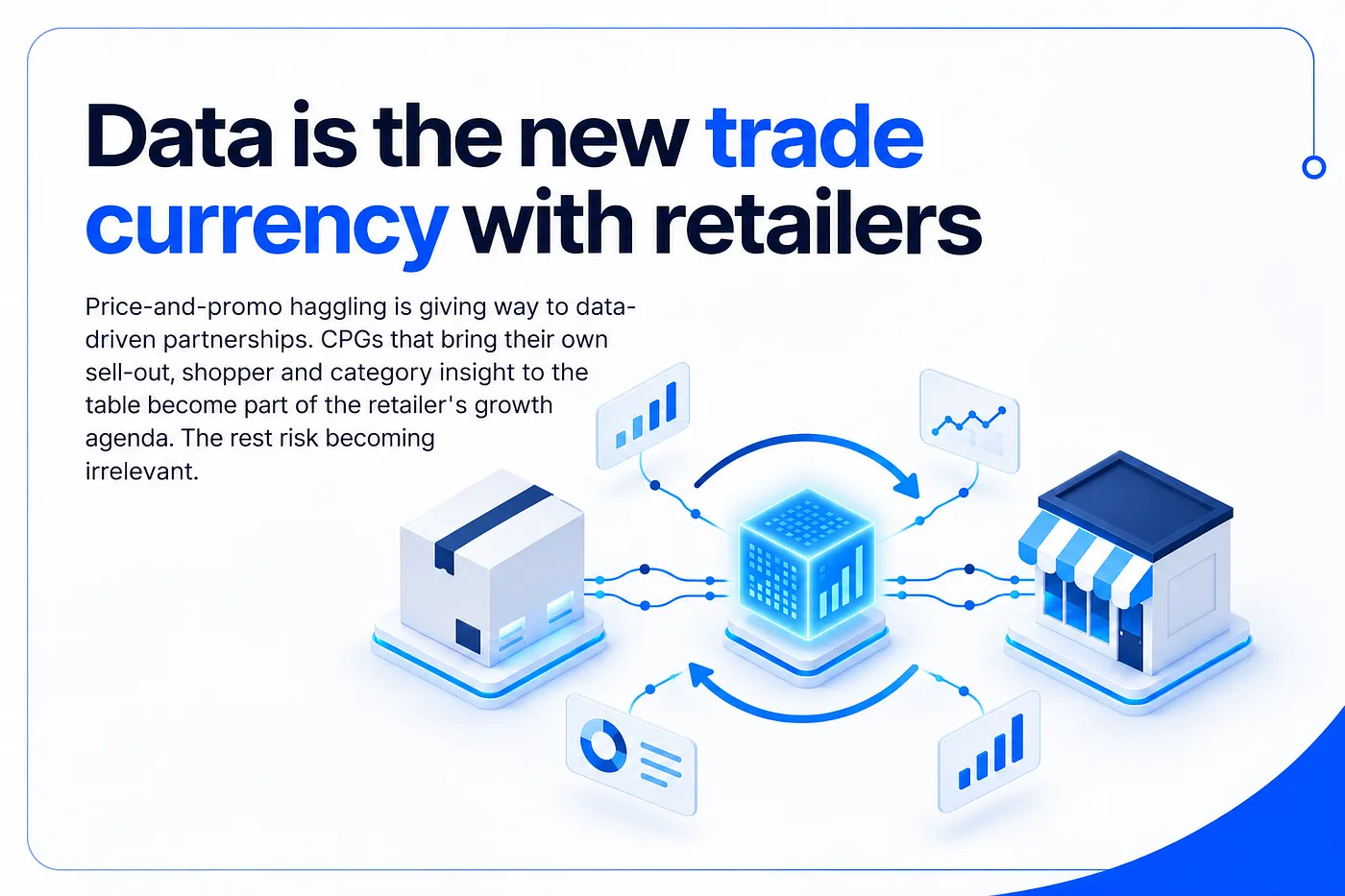
For decades, CPG companies knew their shoppers better than anyone else in the chain. They ran the consumer research, built the brands and decided what went on the shelf. That advantage is slipping.
In new research published on 29 October 2026, Bain & Company argues that retailers have reinvented themselves as private-label manufacturers, media sellers and data and technology companies. Along the way, they have built better consumer data than the CPGs that supply them. For commercial, key account and RGM leaders, that changes what happens at the negotiating table.
The numbers behind the shift
Start with where retailer profits come from. Bain expects that by 2035 nearly half of all retailer profits will come from "beyond trade": retail media, marketplaces, payments and data. That share was about 10% in 2021 and around 25% in 2024. US retail media spending alone reached $58.8 billion in 2025.
The agenda for joint business planning is moving with it. Retail partners now expect about 80% of joint business plan (JBP) discussions to focus on consumer and shopper data, retail media and category growth, rather than pricing, promotions and assortment. A key account manager who arrives with only a promo calendar and a price list is preparing for the wrong meeting.
Then there are AI shopping agents. Bain estimates that agentic commerce alone will influence about $1 trillion in US consumer spending by 2030, and nearly half of US shoppers already use AI to help them shop. Agents reward concrete, review-backed product attributes over brand equity. In Bain's words: "If an agent doesn't select you, you don't exist."
Why retailers pulled ahead
Retailers sit closest to the shopper. Every loyalty card swipe, basket and online search lands in their systems, and over the past decade they invested heavily to turn that into insight and revenue. Shoppers are also discovering products in more places, from social feeds to quick commerce and AI assistants, and many of those channels belong to retailers or platforms rather than brands.
Meanwhile, many CPG commercial teams still work from data in pieces. Sell-in sits in the ERP, distribution in distributor files, in-store execution in field reports and sell-out in a different portal for each retailer. We wrote about the cost of this in Breaking the Silo Deadlock: when every function has its own version of the numbers, nobody can see the full picture fast enough to act on it.
What Bain recommends
Bain does not argue that CPGs are finished. It argues that the ones who change their commercial model now can come out stronger, and it sets out four bets. Win on the "next shelf" (social, agentic and quick commerce). Reinvent how you work with retailers. Reimagine frontline ways of working with AI. Build proprietary intelligence that competitors cannot copy.
Two of those bets land directly on sales teams. Bain expects key account managers to stop building pricing, promotion and assortment scenarios by hand and to manage AI agents that do it for them. In traditional trade, AI can turn outlet-level data into a prioritised call plan for each rep, so fewer visits are wasted.
The other shift is in the retailer relationship itself. Bain describes a move from transactional supplier deals to data-driven partnerships and longer-term joint planning, where the CPG becomes part of the retailer's growth agenda instead of a line in the trade-terms negotiation.
Bring your own data to the table
None of this works if your own data is in pieces. You cannot bring shopper and category insight to a JBP if it takes a week to reconcile what you shipped with what actually sold. Comparing the two is the starting point, as we explained in How to Compare Sell-In and Sell-Out for Better Business Insights. It also has to be trustworthy: poor data quality leads straight to weak arguments in front of a buyer.
The same applies to AI. Agents that build promo scenarios or call plans are only as good as the data they read. As we argued in Agentic AI Won't Fix CPG Growth If Your Data Is Still in Pieces, connecting the data comes before automating the decisions.
That is what SalesData is built for. We connect the full sales cycle, from sell-in through distribution and in-store execution to sell-out, in one view. Your key account team walks into each retailer meeting with the same numbers as everyone else in the company, from promotion results to competitor prices, and your AI works from the same source of truth.
What data will you bring to your next JBP?
Here is a simple test before your next retailer meeting. Can your team show, for that account, what you sold in, what reached the shelf, what sold out and how the last promotion performed, all from one set of numbers? If that takes days of spreadsheets, the retailer will set the agenda with its data, not yours.
We help CPG commercial teams close that gap. Talk to us to see what your own sell-in and sell-out data can do.
Related reading: 94% Are Transforming. Only 9% Have Made It Stick · Plan, Execute, Learn, Repeat: How Longa Vida Closes the Loop on Special Displays
Source: Bain & Company, Want to Lead in Consumer Products? Adapt to Retailing's New Reality, 29 October 2026.